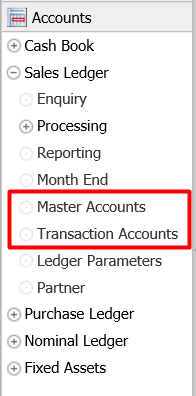
The sales ledger consists of two levels allowing for increased management control of the ledger – these two levels are known as the Master and Transaction account levels. The Master account level determines key policy and trading rules such as the account terms and account type. The Transaction account level holds the daily trading activity and credit limits. Controls can be actioned at either of these levels.
The ability to store master and transaction level accounts offers flexibility, dependent upon the company structure and on the requirements of the businesses to which parts or services are sold to. The diagram below explains the relationship between a master account at enterprise level and numerous transaction accounts stored at divisional level in the system – assuming that a multiple division set up exists:
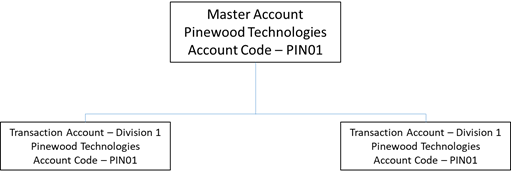
In this set up, each division within the business has a transaction account – allowing individual dealerships to view the debt of their particular customer. By linking both transaction accounts to a single master account, reporting can be consolidated to view the total debt across the divisions at the enterprise level.
Alternatively, it may be feasible that the business to which parts and services are being supplied have different branches that require separate invoices from a single division within the company structure:
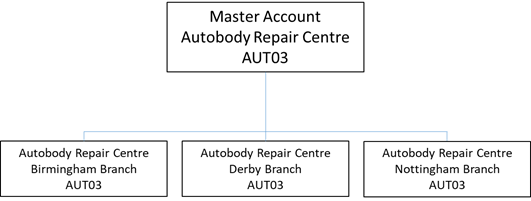
In this way, the Workshop or Parts department can invoice the relevant Sales Ledger account as required by the customer – however, the debt for the customer’s organisation as a whole can still be viewed at enterprise level by the business. Invoices generated via the Parts and Workshop modules are automatically recorded. Invoices may also be raised manually directly from the sales ledger if required. Monies received in payment from customers (known as Receipts) are entered onto the Sales Ledger via the Cashbook to the customer’s account and may be cleared against outstanding invoices. Statements and reports detailing outstanding balances on customer’s accounts may be produced to aid debt recovery. Vehicle debt is dealt with separately within the Vehicles Module – for further information on this process, please refer to the Pinewood DMS Vehicles Guide.
This section of the guide covers all aspects of sales ledger account maintenance, processing and reporting. The process of receipting monies onto the sales ledger is covered within the Cashbook section of this guide.
Sales Ledger - Account Maintenance
The Master Account & Transaction Account section of the module is used to create or amend details of Master or Transaction level sales ledger accounts as required.
Search for the account to be created or amended. In the scenario of creating a sales ledger account for the first time, it is essential to select the Master Account option from the main menu to first search for a Master Account.